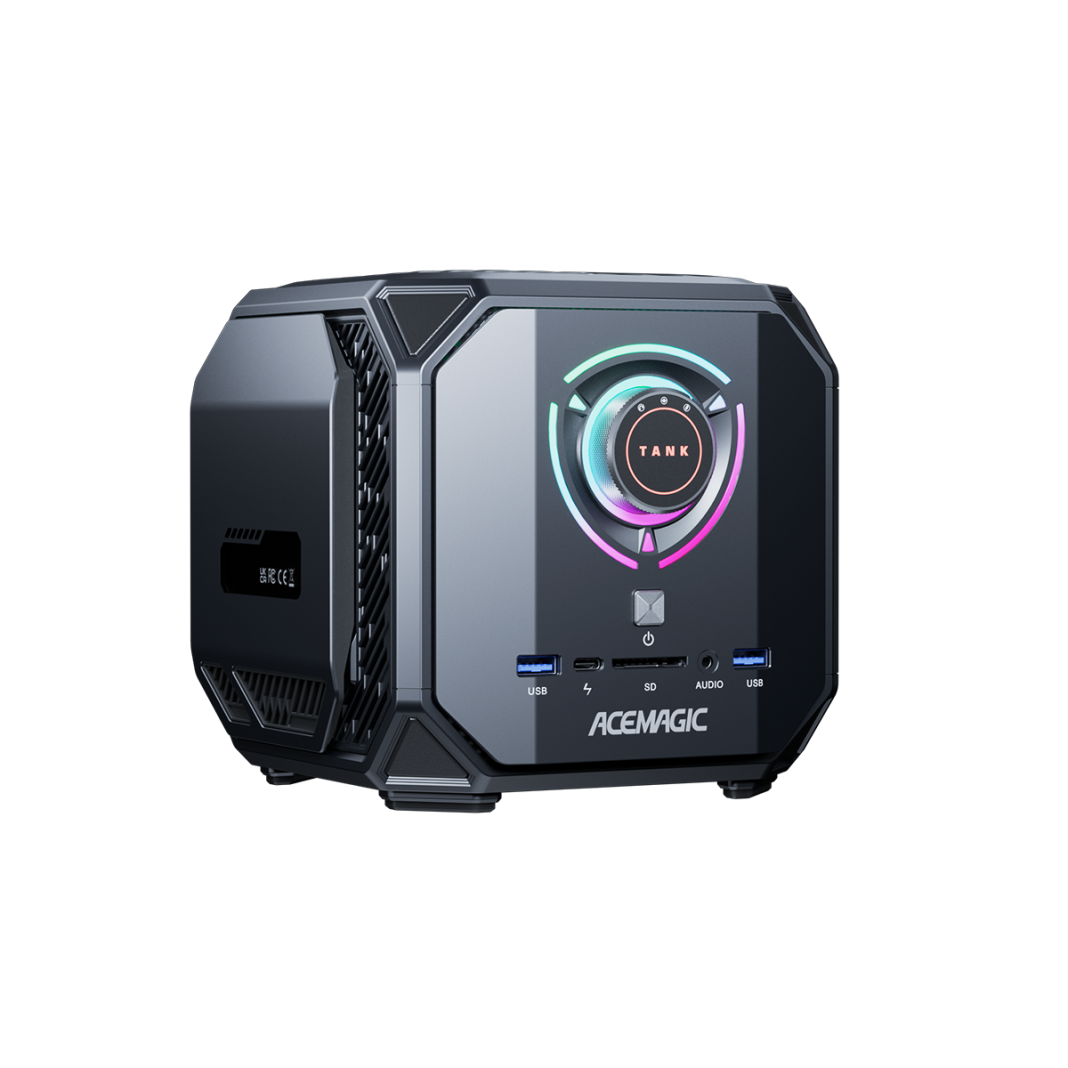

The Thunderobot STATION: Cube Design Over Substance?

Thunderobot has unveiled the STATION — a cube-shaped mini PC built around AMD’s Ryzen AI Max+ 395 processor. Unveiled at CES 2026, it features a distinctive matte black cube-style chassis with about 3 liters of volume, offering robust I/O capabilities and AI-focused design for sustained workloads. But when you look past the unique cube design, does the STATION actually deliver on its promises, or is it just a consumer mini PC with a novelty form factor?
Processor: AMD Ryzen AI Max+ 395 — Great Silicon, Unproven Tuning
The STATION is powered by AMD’s most powerful mobile APU:
- 16 Zen 5 CPU cores with 32 threads
- Up to 5.10 GHz boost clock
- 40 RDNA 3.5 Compute Units as Radeon 8060S graphics
- 50 TOPS NPU for AI acceleration
Thunderobot describes the STATION as an AI-focused mini PC built for sustained workloads and long-term stability rather than peak burst performance. However, Thunderobot is primarily known in the Chinese gaming laptop market, and their track record with Strix Halo mini PC BIOS optimization and thermal tuning remains unproven compared to established brands like GEEKOM, Minisforum, or FAVM.
The Real-World Difference: 50 TOPS vs The Competition
The 50 TOPS NPU is solid, but it’s not the highest available. The Ryzen AI 9 HX 370 (found in Minisforum AI X1 Pro) offers 80 TOPS, making it significantly better for local LLM inference. For AI professionals running 70B parameter models, that extra 30 TOPS can mean the difference between responsive inference and waiting minutes for a response.
Memory and Storage: The 128GB Advantage — But at What Cost?
The STATION supports up to 128GB of LPDDR5X memory at 8,000MHz in an eight-channel configuration. This is where the STATION shines — many competitors cap out at 96GB or 64GB.
However, there’s a catch: Thunderobot’s Western customer support, driver update schedule, and BIOS optimization for Strix Halo remain unproven. The “cube-style” design is novel, but without established Western support channels, buyers are taking a risk on a brand primarily known for gaming laptops in the Chinese market.
Design: Cube Form Factor — Novel or Practical?
The standout feature of the STATION is its cube-style chassis — a distinctive design that sets it apart from the typical rectangular mini PC form factors. The matte black finish gives it a premium look that fits well in any professional environment.
Despite its compact 3-liter volume, it includes an SD card reader and front-facing USB ports. However, the cube design is bulkier than 2-liter competitors like the FAVM FA-EX9 or GEEKOM A7 Max, sacrificing portability for a novelty form factor that offers no performance advantage.
But notably missing: The Thunderobot STATION lacks an OCuLink port, which is a significant omission for users who want eGPU expansion capability. Competitors like FAVM FA-EX9 and Minisforum AI X1 Pro include OCuLink as a standard feature.
How It Stacks Up: The Mini PC Showdown
When you’re shopping for a Strix Halo mini PC, the Thunderobot STATION faces stiff competition:
vs. FAVM FA-EX9 (Ryzen AI Max+ 395, 128GB RAM, ~$1,943 USD):
- The FA-EX9 offers identical processor and memory capacity in a more compact 2-liter form factor
- The FA-EX9 includes an OCuLink port for eGPU expansion; the STATION does not
- The FA-EX9 has established Western distribution and support channels
vs. GEEKOM A7 Max / A9 Max (Ryzen AI Max+ 395, 128GB RAM, ~$1,800–$2,200 USD):
- GEEKOM offers similar specs at competitive pricing with proven BIOS optimization for Strix Halo
- GEEKOM models often include OCuLink and dual USB4 configurations
- The STATION’s cube design is bulkier and less portable than GEEKOM’s offerings
vs. Minisforum AI X1 Pro (Ryzen AI 9 HX 370, 80 TOPS NPU, ~$1,600–$2,000 USD):
- The AI X1 Pro’s 80 TOPS NPU significantly outperforms the STATION’s 50 TOPS for local AI inference
- The AI X1 Pro includes OCuLink + dual USB4 for better expandability
- The STATION’s 128GB RAM is an advantage, but the Minisforum’s superior NPU and OCuLink are more valuable for most users
Community Reviews & Benchmarks
Here’s a comprehensive overview of the Thunderobot STATION cube design and Strix Halo performance from the community:
This overview covers the 3-liter cube chassis design, Ryzen AI Max+ 395 performance in a non-traditional form factor, and real-world benchmarks that help put the $2,000–$2,400 price point into perspective.
The Verdict: Novel Design or Overhyped Form Factor?
The Thunderobot STATION offers impressive hardware with 16-core Ryzen AI Max+ 395, 128GB LPDDR5X-8000 memory, and a distinctive cube-style chassis. However, it comes with significant trade-offs that potential buyers should consider.
Estimated Pricing: ~$2,000–$2,400 USD (£1,600 GBP, €1,850 EUR, AU$3,200 AUD)
The good:
- 128GB RAM configuration is ideal for unquantized 70B+ LLMs
- Distinctive cube-style chassis offers unique aesthetics
- Includes SD card reader and front-facing USB ports for convenience
The bad:
- Lacks an OCuLink port for eGPU expansion — a notable omission at this price point
- Bulkier 3-liter cube chassis sacrifices portability compared to 2-liter competitors
- 50 TOPS NPU is outperformed by the Ryzen AI 9 HX 370’s 80 TOPS in competing models
- Thunderobot’s unproven track record with Strix Halo BIOS optimization and Western customer support
Who should buy it: Users who prioritize unique aesthetics above all else, need 128GB RAM, and don’t care about portability or eGPU expansion.
Who should avoid it: AI professionals who want the best NPU performance (80 TOPS), users who need OCuLink for eGPU expansion, or buyers seeking a compact, portable Strix Halo machine with proven Western support.
Rating: 6/10 — Solid hardware specifications marred by missing features like OCuLink, a bulkier chassis design, and unproven thermal tuning. The cube form factor is novel but doesn’t translate to better performance or value.