
The Lenovo LCFC Ai Mini PC: Enterprise Reliability or Overpriced Rebrand?

Lenovo has entered the Strix Halo mini PC market through its subsidiary LCFC (Legend Capital Financial Corporation), unveiling the LCFC Ai Mini PC — a compact workstation built around AMD’s flagship Ryzen AI Max+ 395 processor. With support for up to 128GB of RAM and a 50 TOPS NPU, it’s positioned as a pocket-sized AI workstation. But at an estimated price point of $2,200–$2,600 USD (approximately £1,750 GBP, €2,000 EUR, or AU$3,400 AUD), you’re paying a significant premium for the Lenovo name. The question is: does enterprise-grade reliability justify that markup?
Processor: AMD Ryzen AI Max+ 395 — Same Chip, Different Price Tag
The LCFC Ai Mini PC is powered by AMD’s most powerful mobile APU:
- 16 Zen 5 CPU cores with 32 threads
- Up to 5.10 GHz boost clock
- 40 RDNA 3.5 Compute Units as Radeon 8060S graphics
- 50 TOPS NPU for AI acceleration
This is the exact same Strix Halo chip found in mini PCs from FAVM, GEEKOM, and Colorful — often at prices $300–$500 lower. Lenovo’s enterprise reputation certainly carries weight, but when you’re paying a 20-30% premium for identical silicon, you need to ask whether the BIOS optimization and thermal tuning actually justify the cost.
The Real-World Difference: 50 TOPS vs The Competition
The 50 TOPS NPU is solid, but it’s not the highest available. The Ryzen AI 9 HX 370 (found in Minisforum AI X1 Pro) offers 80 TOPS, making it significantly better for local LLM inference. For AI professionals running 70B parameter models, that extra 30 TOPS can mean the difference between responsive inference and waiting minutes for a response.
Memory and Storage: The 128GB Advantage
The LCFC Ai Mini PC supports up to 128GB of LPDDR5 memory at 8000MHz in an eight-channel configuration. This is where the LCFC shines — many competitors (like Colorful SMART 900) cap out at 96GB or 64GB. For AI professionals running unquantized 70B+ models, that extra RAM is crucial.
Design and Portability: Enterprise Build, Consumer Form Factor
Lenovo has designed the LCFC Ai Mini PC as a true pocket workstation — compact enough to fit in a briefcase, powerful enough to replace a desktop for AI development and professional tasks. The build quality reflects Lenovo’s reputation for durability and reliability.
The connectivity includes USB4 for high-speed data transfer, HDMI and DisplayPort for multi-monitor setups, and dual Ethernet ports for network-intensive workloads. However, it notably lacks an OCuLink port, which is a significant omission for users who want eGPU expansion capability. Competitors like FAVM FA-EX9 and Minisforum AI X1 Pro include OCuLink as a standard feature.
How It Stacks Up: The Mini PC Showdown
When you’re shopping for a Strix Halo mini PC, the LCFC Ai Mini PC faces stiff competition:
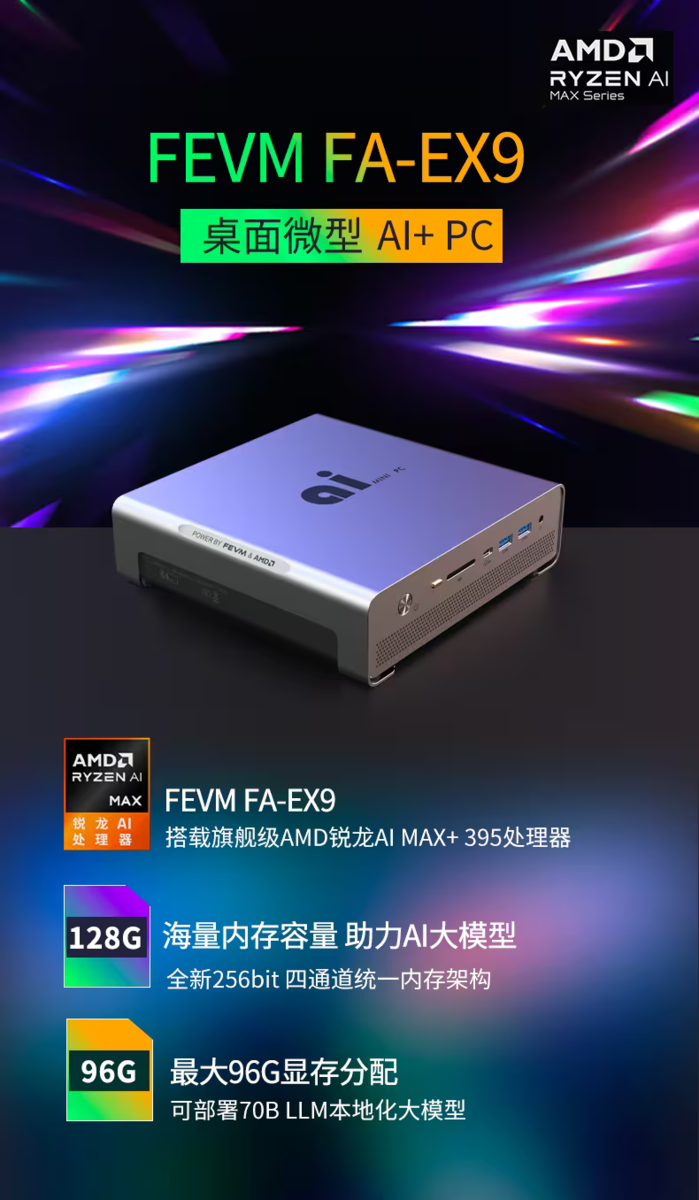
vs. FAVM FA-EX9 (Ryzen AI Max+ 395, 128GB RAM, ~$1,943 USD):
- The FA-EX9 offers identical processor and memory capacity at a significantly lower price point
- The FA-EX9 includes an OCuLink port for eGPU expansion; the LCFC Ai Mini PC does not
- Lenovo’s enterprise warranty and support may justify the premium for corporate buyers
vs. GEEKOM A7 Max / A9 Max (Ryzen AI Max+ 395, 128GB RAM, ~$1,800–$2,200 USD):
- GEEKOM offers similar specs at competitive pricing with established Western support
- GEEKOM models often include OCuLink and dual USB4 configurations
- The LCFC Ai Mini PC’s enterprise branding carries a premium that may not translate to better performance
vs. Minisforum AI X1 Pro (Ryzen AI 9 HX 370, 80 TOPS NPU, ~$1,600–$2,000 USD):
- The AI X1 Pro’s 80 TOPS NPU significantly outperforms the LCFC’s 50 TOPS for local AI inference
- The AI X1 Pro includes OCuLink + dual USB4 for better expandability
- The LCFC Ai Mini PC’s 128GB RAM is an advantage, but the Minisforum’s superior NPU may be more valuable for AI workloads
The Verdict: Enterprise Premium or Overpriced Rebrand?
The Lenovo LCFC Ai Mini PC offers impressive hardware with 16-core Ryzen AI Max+ 395, 128GB memory support, and a 50 TOPS NPU. However, at an estimated price of $2,200–$2,600 USD (£1,750 GBP, €2,000 EUR, AU$3,400 AUD), you’re paying a significant premium for the Lenovo name.
The good:
- 128GB RAM configuration is ideal for unquantized 70B+ LLMs
- Lenovo’s enterprise-grade build quality and warranty support
- Compact, portable design with professional connectivity
The bad:
- Lacks an OCuLink port for eGPU expansion — a notable omission at this price point
- Priced significantly higher than competitors offering identical or superior specs
- 50 TOPS NPU is outperformed by the Ryzen AI 9 HX 370’s 80 TOPS in competing models
Who should buy it: Enterprise buyers and corporate IT departments that prioritize Lenovo’s warranty, support channels, and procurement processes over raw value.
Who should avoid it: AI professionals and power users who want the best performance per dollar, OCuLink expansion capability, or superior NPU performance.
Rating: 7/10 — Solid enterprise hardware marred by premium pricing and missing features like OCuLink. It’s a safe choice for corporations, but a risky one for individual buyers seeking value.