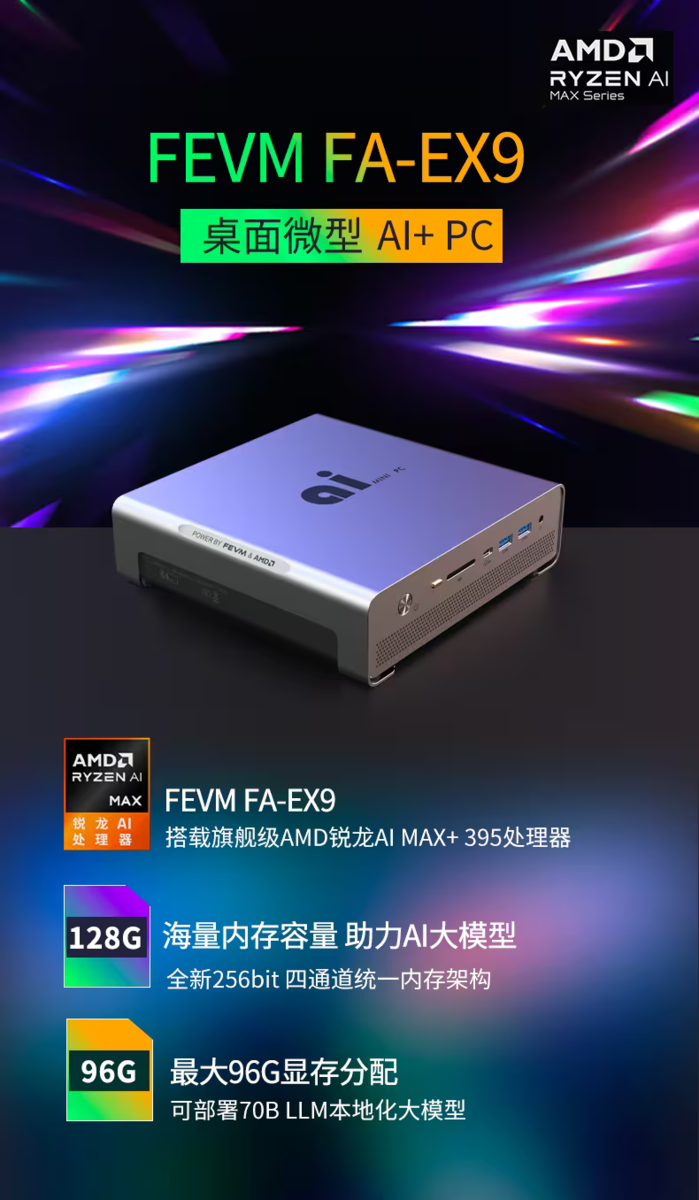


The FAVM FA-EX9: The First Strix Halo Workstation to Challenge Nvidia

FAVM (also known as FEVM) has unveiled its FA-EX9 — a compact AI workstation built around AMD’s flagship Ryzen AI Max+ 395 processor. At approximately $1,943 (CNY 13,999 in China), it’s positioned as a direct challenger to Nvidia’s DGX Spark for AI professionals who need desktop-class performance in a form factor that fits on any desk.
Processor: AMD Ryzen AI Max+ 395 “Strix Halo” — The Ultimate Mobile APU
The FA-EX9 is powered by AMD’s most powerful mobile APU to date — the Ryzen AI Max+ 395 “Strix Halo.” This chip features:
- 16 Zen 5 CPU cores with 32 threads
- Up to 5.10 GHz boost clock
- 40 RDNA 3.5 Compute Units integrated as Radeon 8060S graphics
- 50 TOPS NPU for AI acceleration
- 120W sustained power draw — unlike most mini PCs that throttle their APUs under load
The Real-World Difference: 50 TOPS vs The Competition
Let’s put those 50 TOPS into perspective. When you’re running local LLMs like Llama 3 70B or Qwen 2.5 72B, the NPU makes a dramatic difference in inference speed and power efficiency. Compared to the Ryzen AI 9 HX 370 (which offers 80 TOPS), the FA-EX9’s 50 TOPS NPU is still significantly ahead of Intel’s Core Ultra 9 285H (13-14 TOPS).
In practical terms, this means:
- Faster local LLM inference — models that take minutes on lesser NPUs can respond in seconds
- Better power efficiency — the NPU handles AI tasks without maxing out the CPU/GPU, extending battery life and reducing heat
- Larger model support — 50 TOPS allows for more complex quantization schemes while maintaining responsive inference speeds
Memory and Storage: Built for Heavy Lifting
The FA-EX9 supports up to 128GB of LPDDR5 memory at 8000MHz, all running in an eight-channel configuration. This massive memory capacity is essential for running large AI models locally without hitting swap — a game-changer compared to most mini PCs that cap out at 64GB.
Storage is handled through M.2 NVMe SSD slots, with configurations available up to 8TB. The compact 2-liter chassis (192 × 190 × 55mm) leaves little room for expansion, but the PCIe 4.0 interface ensures blazing-fast read/write speeds for AI model loading and data processing.
Connectivity That Doesn’t Compromise
Despite its small size, the FA-EX9 doesn’t compromise on connectivity:
- HDMI 2.1 for 8K display output
- DisplayPort 2.1 for high-refresh-rate monitors
- USB4 for 40Gbps data transfer and eGPU support
- OCuLink port — a rare feature that enables direct eGPU expansion with minimal bandwidth loss
The OCuLink port is particularly notable — it’s a feature typically found only in larger workstations, and it makes the FA-EX9 one of the most upgradeable mini PCs available.
How It Stacks Up: The Mini PC Showdown
When you’re shopping for a high-end AI workstation, the FA-EX9 faces competition from a few notable players:
vs. Minisforum AI X1 Pro (Ryzen AI 9 HX 370):
- The AI X1 Pro offers an 80 TOPS NPU vs the FA-EX9’s 50 TOPS — a clear win for pure AI acceleration metrics
- However, the FA-EX9 supports up to 128GB RAM vs the AI X1 Pro’s 64GB limit — crucial for running unquantized 70B+ models
- The FA-EX9’s 120W sustained power draw gives it better thermal headroom for sustained workloads
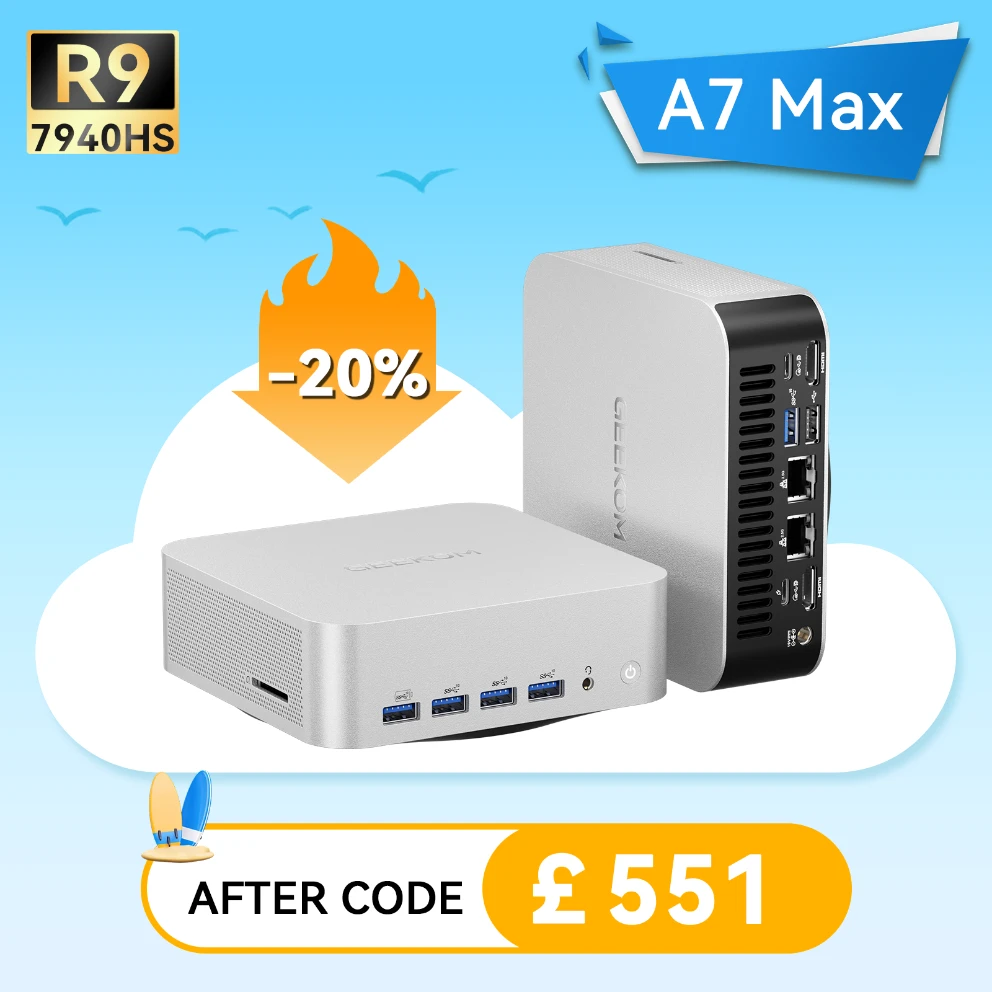
vs. GEEKOM A9 Max / A7 Max (Ryzen AI Max+ 395):
- The FA-EX9 shares the same Ryzen AI Max+ 395 processor, offering similar iGPU and NPU performance
- GEEKOM’s models often have more consumer-focused designs and wider availability in Western markets
- The FA-EX9’s OCuLink + dual USB4 combo gives it an edge in professional expandability
Who Is It For?
The FA-EX9 is squarely aimed at AI professionals, developers, and power users who need:
- Desktop-level CPU performance for compiling, rendering, and data processing
- Massive memory capacity (up to 128GB) for running large language models locally
- Upgradeable GPU capability through the OCuLink port for accelerated workloads
- Quiet operation — crucial for home offices and studios where noise matters
Final Verdict: A Pioneering Strix Halo Workstation
The FAVM FA-EX9 represents the cutting edge of what’s possible in a 2-liter chassis. With its 16-core Zen 5 processor, 128GB memory support, and OCuLink eGPU capability, it’s one of the most powerful mini PCs ever built — and one of the few that can genuinely challenge desktop workstations.
If you’re an AI professional or power user who needs Strix Halo performance with maximum RAM capacity and upgradeability, the FA-EX9 is worth serious consideration. At $1,943, it’s not cheap, but it’s positioned as a more affordable alternative to Nvidia’s DGX Spark while offering comparable AI performance through AMD’s powerful integrated graphics and NPU.
Rating: 9/10 — An exceptional balance of AI performance, memory capacity, and expandability. The only minor drawback is its China-first availability and premium pricing, but for those who can access it, the FA-EX9 is a game-changer.